
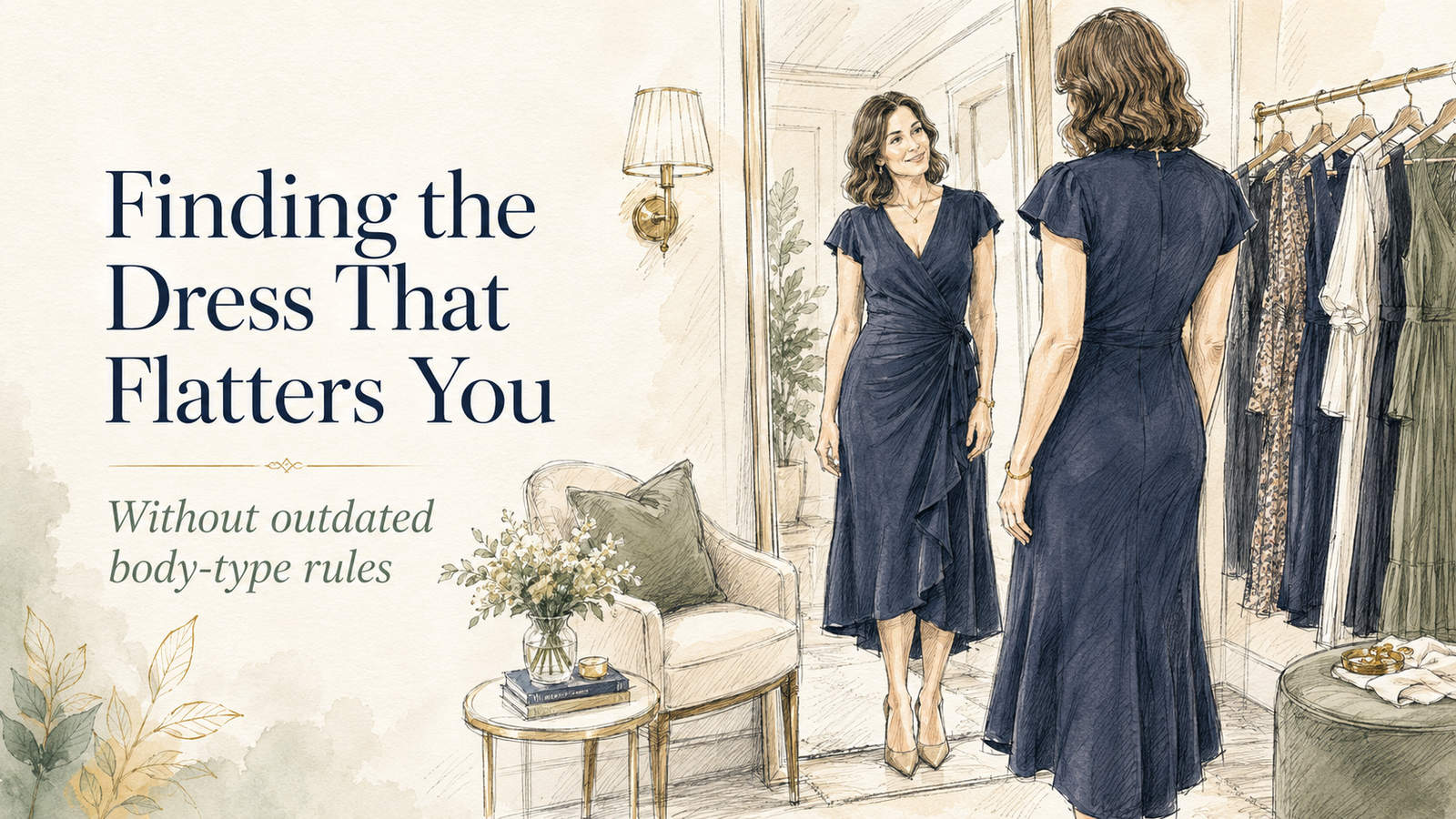
If you have ever wondered how to find a flattering dress, you have probably come across plenty of advice about dressing for an apple, pear, hourglass or rectangle body shape.
These guides can sometimes be useful, but finding the right dress is rarely as simple as matching your body to a category.
A truly flattering dress is one that works with your proportions, movement, comfort and personal style. The neckline should sit properly. The waist should fall in the right place. The fabric should move the way you want it to. And, most importantly, you should feel comfortable enough to enjoy wearing it.
At Thread & Trend Fashion in Melbourne, we see how dramatically the same dress can fit two women who technically wear the same size. Small differences in torso length, shoulders, bust position, height and proportions can completely change how a garment sits.
So instead of asking:
“What dress should I wear for my body type?”
A much more useful question is:
“How does this particular dress work on me?”
What Actually Makes a Dress Flattering?
The word flattering is often used to mean making someone look taller, thinner or smaller.
That is far too limiting.
A flattering dress is better understood as a dress that creates the proportion, shape and overall effect you want, while fitting comfortably and allowing you to move naturally.
Five elements make a particularly important difference:
- neckline and shoulder fit
- waist placement
- fabric and construction
- dress length and proportion
- movement and comfort
Getting these elements right is usually far more useful than following rigid rules about body shape.
1. Start With the Neckline and Shoulders
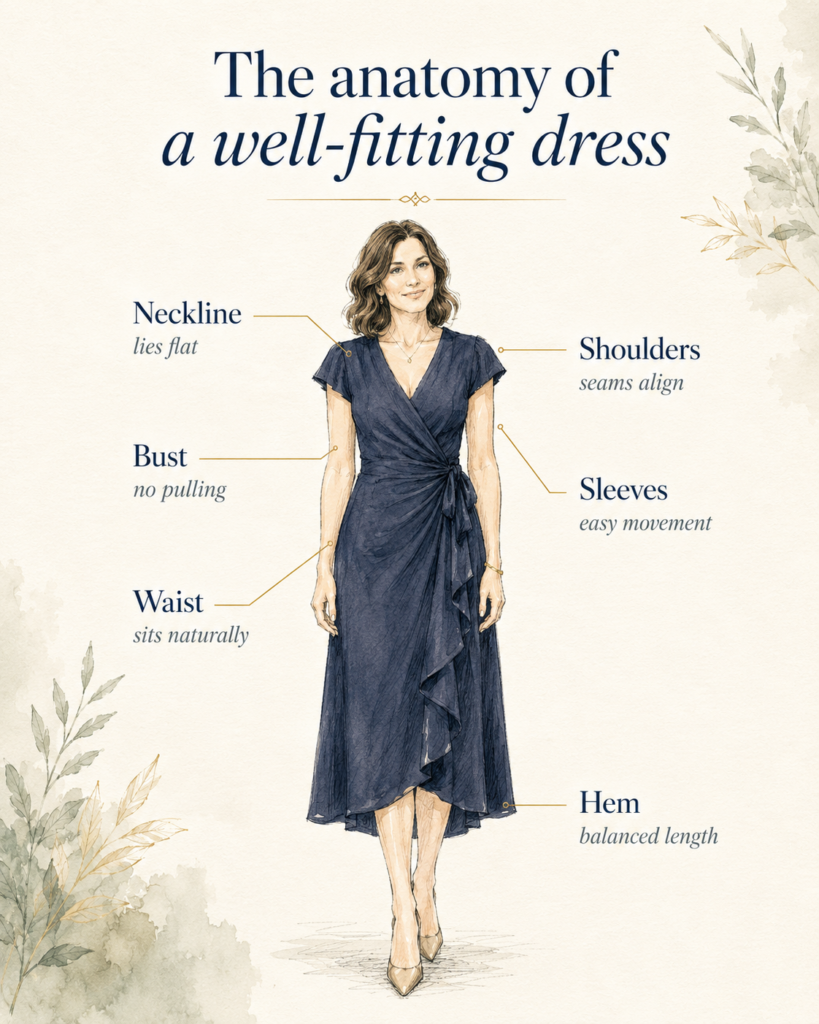
When trying to find a dress that flatters you, start at the top.
The neckline frames your face and influences the visual balance of the entire dress. Different necklines create very different effects.
A V-neck creates a strong vertical line. A high neckline can create a clean, sophisticated silhouette. An off-the-shoulder neckline emphasises the shoulders and collarbone, while an asymmetric neckline can add movement and visual interest.
But the style of neckline is only part of the story.
The fit matters just as much.
When trying on a dress, check:
- Does the neckline sit flat?
- Do you find yourself constantly smoothing the skirt?
- Perhaps the straps keep slipping?
- Does the dress feel secure?
- Can you move without repeatedly adjusting it?
- Does it work with the underwear you intend to wear?
A beautiful neckline that needs constant adjustment will quickly become frustrating during a long event.
The most flattering neckline is therefore not simply the one that supposedly suits your body shape. It is one that creates the look you want and stays comfortable and secure while you wear it.
2. Check Where the Waistline Actually Sits
Waist placement is one of the most important—and most overlooked—parts of dress fit.
A dress can technically be your size but still look wrong because its waist seam does not match your natural proportions.
You may have a longer or shorter torso than the pattern used to construct the dress. As a result, the waistline may sit slightly too high or too low.
That small difference can affect the entire silhouette.
When trying on a dress, look at the waist from the front and the side.
Ask yourself:
- Does the waist sit naturally?
- Does it stay in position when I sit?
- Is fabric gathering or pulling around it?
- Does the skirt fall smoothly from the waist?
- Do the proportions of the bodice and skirt feel balanced?
Do not assume there is something wrong with your body if the waist does not sit correctly.
Sometimes the proportions of the garment simply do not match yours.
And sometimes a relatively small alteration can make a significant difference.
3. Pay Attention to Fabric, Not Just Shape
Two dresses with almost identical silhouettes can look completely different because of their fabrics.
That is why learning how to choose the right dress also means understanding what the fabric is designed to do.
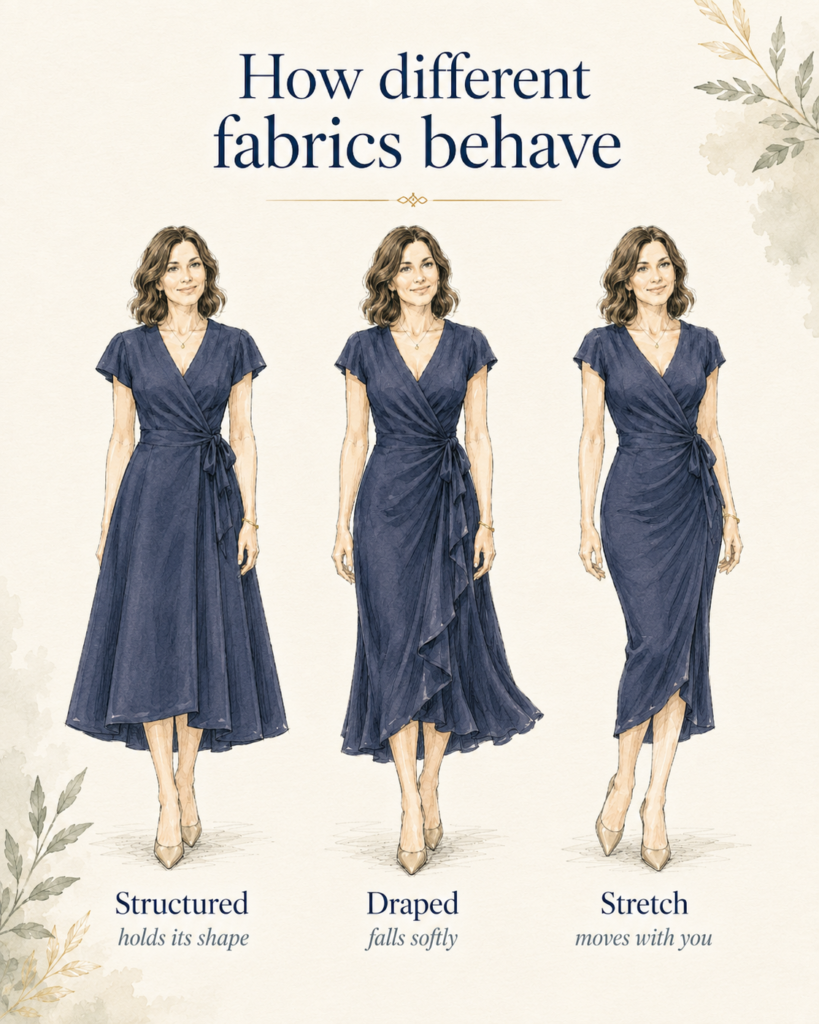
A structured fabric can hold its shape away from the body and create a defined silhouette.
A softer fabric may drape and follow the body’s movement.
Stretch fabrics can provide additional flexibility, while non-stretch fabrics generally depend more heavily on accurate construction and fit.
Consider fabrics such as:
Satin
Creates highlights and shadows as you move and often gives a dress a more polished or formal appearance.
Chiffon
Provides softness, movement and volume without necessarily feeling heavy.
Structured woven fabrics
Can create more architectural silhouettes and defined lines.
Stretch fabrics
May provide greater freedom of movement and adapt more easily to different proportions.
Do not judge the fabric only while standing in front of a mirror.
Walk in the dress.
Sit in it.
Look at how it moves.
Notice whether the fabric falls naturally or pulls across particular areas.
The right fabric can be just as important as the right dress shape.
4. Consider Dress Length as Part of the Whole Outfit
One of the most common dress-shopping questions is whether someone should wear a mini, midi or maxi dress.
Again, there is no universal rule.
The same midi dress may sit below the knee on one woman and close to the ankle on another. A maxi dress can look dramatically different depending on the waist position, volume of the skirt and shoes worn with it.
Rather than deciding that your height automatically excludes a particular length, consider the complete outfit.
Think about:
- where the hem falls on you
- skirt volume
- waist placement
- your shoes
- heel height
- the occasion
- how much walking or dancing you will do
A long dress does not automatically overwhelm a shorter woman, just as a shorter dress is not automatically more flattering.
Proportion matters more than the label mini, midi or maxi.
5. Test the Dress While Moving
One of the simplest ways to tell whether a dress fits properly is to stop standing still.
A fitting-room mirror only shows you one moment.
At the actual event, you may be:
- walking
- sitting
- getting into a car
- climbing stairs
- greeting people
- raising your arms
- eating
- dancing
A dress needs to work during those moments too.
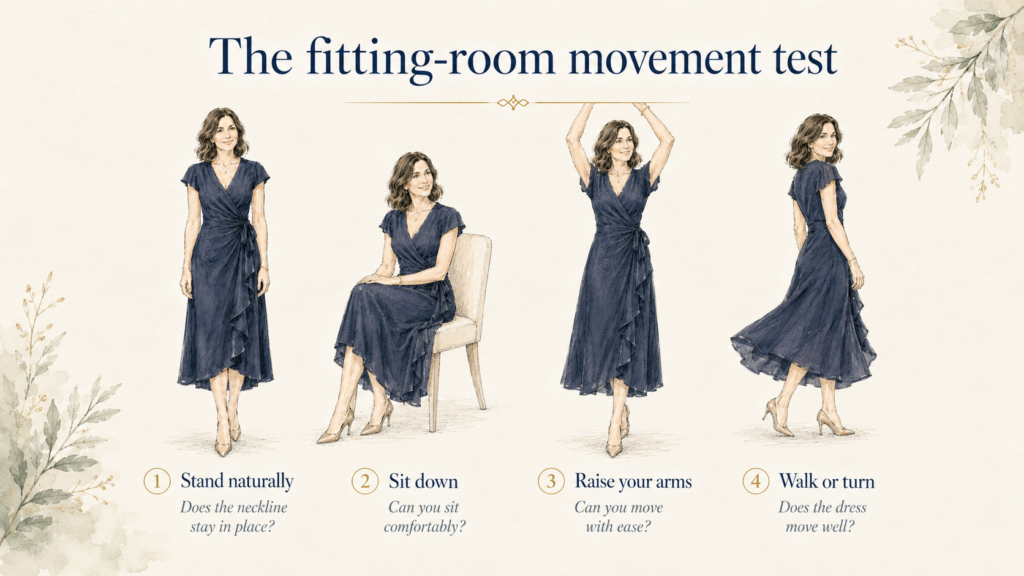
When trying it on, walk normally.
Sit properly rather than carefully balancing on the edge of the chair.
Move your shoulders.
Raise your arms.
Take a full breath.
Then pay attention to what happens.
Are the straps slipping?
Does the neckline move?
How much does the skirt rise when you sit?
Is the bodice pulling across your back?
Are you constantly smoothing or repositioning the dress?
A little adjustment is normal when getting dressed. Having to manage your dress throughout an entire event is different.
The goal is not necessarily to find a formal dress that feels like activewear. Some designs naturally require a little compromise.
The important thing is knowing what that compromise is before you buy the dress.
6. Do Not Let the Size Label Choose the Dress
Another common mistake when shopping for a flattering dress is becoming too attached to your usual size.
Women’s clothing sizes are not perfectly consistent between different labels, styles or even individual garments.
Your usual size should therefore be treated as a starting point, not a verdict.
Instead, look at the actual fit.
Check whether:
- the shoulder seams sit correctly
- the bust is comfortable
- the fabric falls without excessive pulling
- the waist sits in the right position
- side seams remain reasonably straight
- you can sit and move comfortably
A dress closing does not necessarily mean a dress fits.
Equally, needing to try a larger size does not mean anything meaningful about your body.
Choose the size that gives the garment the best foundation for fitting properly.
7. Remember That “Almost Right” Can Sometimes Be Fixed
Ready-to-wear dresses are made using standardised patterns and proportions.
Real bodies are far more varied.
That means it is perfectly possible to find a dress you love where almost everything works—but one small detail does not.
Perhaps:
- the straps are slightly too long
- the waist needs to come in
- the hem needs shortening
- the bodice needs a small adjustment
- the dress needs slightly more shaping through the back
This is where alterations can transform the fit.
Not every alteration is practical, however.
Shortening a relatively simple hem may be straightforward, while altering a heavily embellished hem can be much more complicated. Taking a garment in may be possible, while letting it out depends on the available seam allowance. Major changes to structured shoulders or a complex bodice can require significant reconstruction.
Before rejecting an otherwise beautiful dress, it can therefore be worth asking:
“Can this part of the fit be altered?”
At Thread & Trend, fit and possible alterations can be discussed during your showroom visit, helping you understand what can realistically be adjusted before making your decision.
8. Try One Dress You Would Normally Ignore
Most of us arrive at a dress shop with assumptions about what suits us.
“I can’t wear strapless dresses.”
“Long dresses make me look short.”
“I always feel more comfortable with sleeves.”
“Fitted dresses never seem to suit me.”
“Bright colours just aren’t for me.”
Some of these preferences come from genuine experience.
Others may have started with one dress that did not fit properly—or with a rule someone gave us years ago.
Instead of abandoning everything you know about your style, try a simple experiment.
Take one dress into the fitting room that you would normally leave on the rack.
Try:
- a different neckline
- an unexpected colour
- a more structured fabric
- a softer silhouette
- a longer or shorter length
- a different waist position
You may decide immediately that it is not for you.
That is completely fine.
But occasionally the dress you almost ignored teaches you something new about your personal style.
9. Think About the Occasion, Not Just Your Body
The best dress for you also needs to be the right dress for where you are going.
A beautiful dress can become a poor choice if it does not suit the actual event.
Consider:
- Is the occasion formal, cocktail or relaxed?
- Will it be indoors or outdoors?
- What will the Melbourne weather be like?Will you be standing for long periods?
- Will there be considerable walking?
- What about dancing?
- What shoes will you realistically wear?
- How many hours will you be in the dress?
This becomes especially important when choosing a dress for weddings, milestone birthdays, formal dinners, races, celebrations and other special occasions.
A dress is not truly successful if you spend the entire event worrying about it.
10. Give Yourself Enough Time to Decide
The environment in which you shop can influence your decision more than you might realise.
A busy fitting room, poor lighting, queues, sales pressure and too many opinions can make it difficult to evaluate a dress properly.
A more relaxed fitting gives you time to:
- compare sizes
- walk and sit in the dress
- see it from different angles
- consider alterations
- compare different silhouettes
- think about shoes and accessories
- decide without feeling rushed
This is one of the reasons Thread & Trend Fashion offers a private dress-showroom experience in Bulleen, Melbourne.
You can explore different styles, assess how they actually fit and take the time to decide what feels right for you.
The objective should not be to find the dress that receives the quickest compliment.
It should be to find one you understand, how it fits, how it moves, what can be adjusted and how you feel wearing it.
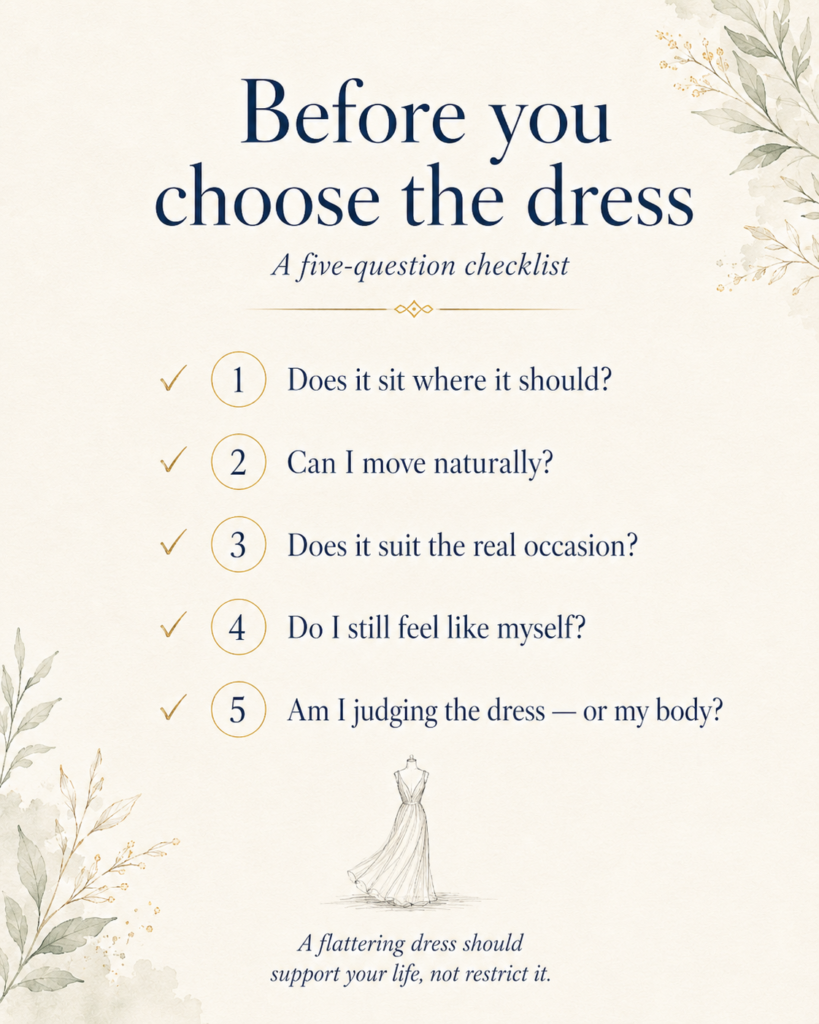
A Simple Flattering-Dress Checklist
Before deciding on a dress, ask yourself these seven questions:
1. Does the neckline sit properly?
It should feel secure without excessive pulling, gaping or adjustment.
2. Is the waist in the right place?
Check whether it aligns comfortably with your proportions and remains in position when you move.
3. Does the fabric fall naturally?
Look for unnecessary pulling, twisting or bunching.
4. Can I move comfortably?
Walk, sit, raise your arms and breathe normally.
5. Does the length work with my shoes and the occasion?
Judge the whole outfit rather than the hem in isolation.
6. Can any small fitting problems be altered?
A minor adjustment may sometimes transform an almost-right dress.
7. Do I actually feel like myself?
A dress can fit technically and still feel wrong. Personal style matters.
If you are choosing an outfit for an upcoming celebration, our Melbourne wedding guest style guide covers dress codes, venues, seasons and styling ideas.
Frequently Asked Questions About Finding a Flattering Dress
What makes a dress flattering?
A flattering dress is one that creates balanced proportions, fits correctly, moves comfortably and produces the overall look you want. Neckline, waist position, fabric, construction and length can all influence how a dress looks and feels.
What dress style is best for my body shape?
Body-shape guides can provide ideas, but they should not determine what you are allowed to wear. Two people with the same general body shape may have different heights, torso lengths, shoulder widths and proportions. Trying different silhouettes is often more useful than relying exclusively on a body-type category.
How do I know if a dress fits properly?
Check the shoulders, neckline, bust, waist and seams while standing, then walk, sit and raise your arms. A well-fitting dress should remain reasonably secure and comfortable without requiring constant adjustment.
Can alterations make a dress more flattering?
Yes, depending on the construction. Adjusting straps, waistlines, hems or certain areas of the bodice can sometimes significantly improve a dress. More complex alterations depend on the garment’s fabric, seams, embellishment and construction.
Where can I try on women’s dresses in Melbourne?
Thread & Trend Fashion offers a relaxed private dress-showroom experience in Bulleen, Melbourne, where you can explore different dresses, compare fits and discuss styling and alteration options before deciding.
Finding the Right Dress Is About You, Not a Formula
Learning how to find a flattering dress does not require memorising a list of rules about what your body should or should not wear.
Pay attention to the garment instead.
Where does the neckline sit?
Where does the waist fall?
How does the fabric behave?
Can you move naturally?
Does the length work with the complete outfit?
Can a small alteration improve the fit?
And finally:
Do you feel like yourself when you wear it?
The right dress may be fitted or flowing, understated or dramatic, midi or maxi, structured or soft. It may be exactly what you expected—or something you nearly walked past.
A flattering dress should not make you spend the evening thinking about your body or constantly adjusting your clothes.
It should give you enough comfort and confidence to forget about the dress for a while and enjoy the occasion.
Explore the Thread & Trend dress collection or book a private showroom visit in Melbourne to discover different styles and find the fit that works for you. Additionally, if you are looking for a special dress for your next Melbourne event, Thread & Trend Fashion is running a monthly dress giveaway in Melbourne, with one featured dress awarded each month through December 2026.
Comments are closed